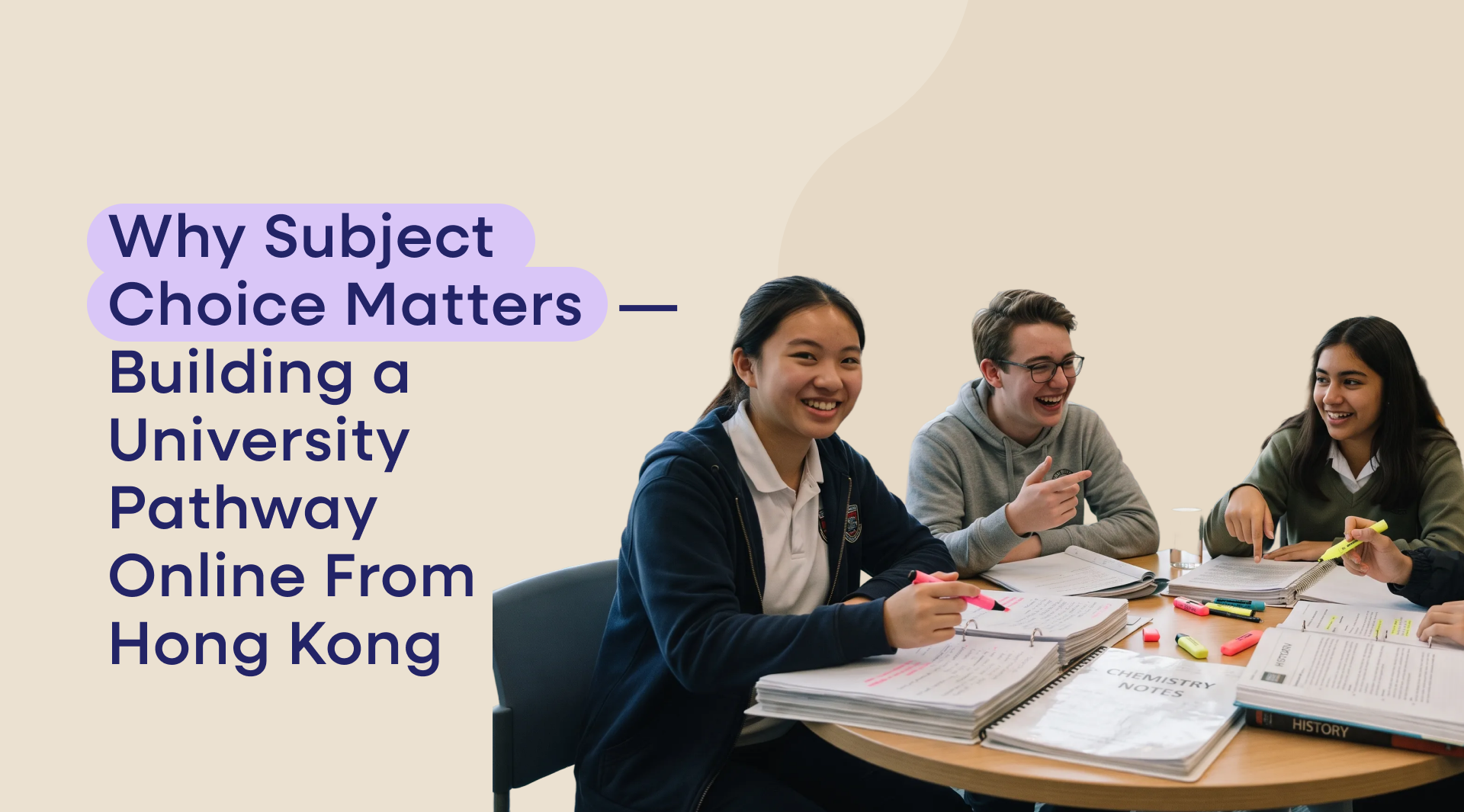
Why Subject Choice Matters — Building a University Pathway Online From Hong Kong
One of the quieter but most consequential limitations of a physical school is the subject package: the combinations a school can offer are constrained by its timetable, staffing and class sizes. For a student with clear university ambitions, that can mean compromising on exactly the subjects their future course requires. This guide explains why subject choice matters so much, and how studying online from Hong Kong removes the constraint.
Subject choice matters because A Level and International GCSE subjects directly determine which university courses a student can apply to — yet at many schools, subject options are constrained by fixed packages or timetable clashes. An online school removes that constraint: a student can build the exact subject combination their intended degree requires, taught by specialists, without being limited by one school's available options. For ambitious Hong Kong families targeting competitive universities and specific courses like medicine, engineering or law, this subject-level control can be the difference between an application that fits and one that falls short.
One of the quieter but most consequential limitations of a physical school is the subject package: the combinations a school can offer are constrained by its timetable, staffing and class sizes. For a student with clear university ambitions, that can mean compromising on exactly the subjects their future course requires. This guide explains why subject choice matters so much, and how studying online from Hong Kong removes the constraint.
Why subject choice shapes university options
University courses specify entry requirements in terms of subjects, not just grades. Medicine requires Chemistry and usually Biology. Engineering requires Mathematics and often Physics. Economics degrees frequently require Mathematics. Architecture may want a mix of Mathematics, Physics and an art or design subject. Law and many Humanities degrees value essay-based subjects such as History or English.
This means a student's A Level choices, made at around 16, directly open or close university doors two years later. Choosing the wrong combination — or being unable to access the right one — can quietly rule out a course before the application is even written. For ambitious students, getting subject choice right is one of the most important academic decisions of their school years. Read how AS Levels support university applications.
How fixed school packages limit students
At a physical school, subject availability is shaped by practical constraints. A school can only offer subjects it has specialist teachers for, and it groups subjects into "blocks" or "option pools" to fit the timetable — which means certain combinations are simply impossible if two required subjects sit in the same block. A student wanting, say, both Further Mathematics and a particular science and an essay subject may find their school's timetable does not allow it.
The result is that some students compromise: they take the closest available combination rather than the ideal one, or drop a subject their university course would have valued. At a competitive school with a strong reputation, families sometimes assume this is unavoidable. It is not — it is a function of the physical timetable, and online study removes it. See how Teneo's academic approach works.
How studying online removes the constraint
An online school is not bound by a single physical timetable in the same way. At Teneo, the model is built around subject-level selection: students can take the combination that matches their university goals, taught by specialist teachers for each subject, rather than accepting a predetermined package. A student targeting medicine can take exactly the sciences they need; one heading for engineering can build the mathematics-and-physics-heavy combination required; one aiming at law can choose the essay subjects that suit. Explore the British curriculum pathway and subject options.
This is one of the clearest, most concrete advantages of online study for ambitious students, and it is the core angle for high-achieving Hong Kong families: your child's university pathway should not be limited by which subjects one school happens to offer.
Subject choice plus the freedom to accelerate
Subject control pairs powerfully with another feature of a well-designed online school: the ability for motivated students to move at their own pace within structure. At Teneo, students can work up to around three weeks ahead while still attending live classes for reinforcement and teacher feedback — so an able student can be genuinely stretched rather than held to the class average, without becoming isolated. For a high-achieving student building an ambitious subject combination, this combination of the right subjects and room to accelerate is exactly the environment that suits them. See how the school day works.
Getting subject choice right: practical guidance
Start from the destination. Identify the likely degree or field, then check the subject requirements of several relevant university courses — they are published on university websites.
Cover the essentials first. Lock in any subjects the intended course explicitly requires (for example, Chemistry for medicine).
Keep options open where uncertain. If the child is undecided, choose widely-respected facilitating subjects — Mathematics, the Sciences, English, History — which keep the most doors open.
Avoid unnecessary narrowing. Do not drop a subject that keeps a desirable path open unless there is a good reason.
Get expert input. A good admissions and academic team can map subject choices to university destinations. Teneo's advisors guide families through exactly this. Speak to an enrolment consultant.
A worked example: the medicine applicant
Consider a Hong Kong student who decides, partway through secondary school, that they want to study medicine. Most medical schools require Chemistry and Biology at A Level, with many preferring a third subject such as Mathematics or Physics. At a physical school, this student's options depend entirely on whether those subjects sit in compatible timetable blocks and whether the school has specialist teachers for each. If Chemistry and Biology happen to clash, or if a strong Biology teacher is not available, the student faces a genuine problem at exactly the moment their choices matter most.
Studying online removes that risk. The student takes Chemistry, Biology and their chosen third subject, each taught by a specialist, in a combination built around the medicine pathway rather than around a timetable. They can also be stretched — working ahead where ready — which suits the kind of high-achieving student who targets medicine. The same logic applies to engineering (Mathematics and Physics), to economics (Mathematics), or to any course with specific subject demands. The principle is consistent: the university requirement should drive the subject choice, not the other way around. Explore the subject options.
It is worth adding that subject choice is not only about the most competitive courses. Even for a student with broad or undecided ambitions, the freedom to assemble a coherent, well-regarded combination — rather than whatever a timetable permits — matters. A student who keeps Mathematics, a science and an essay subject together, for instance, preserves an unusually wide range of future options. The ability to make that choice cleanly, without compromise, is precisely what subject-level flexibility provides, and it is why ambitious Hong Kong families increasingly weigh subject control as heavily as any other factor when choosing how their child will study.
Frequently asked questions
Because university courses specify subject requirements, not just grades. A Level choices made at around 16 directly determine which degrees a student can apply to — so choosing the right combination, and being able to access it, is one of the most important academic decisions of the school years.
Can my child choose any subject combination at an online school? At an online school built around subject-level selection, like Teneo, students can take the combination their university pathway requires, taught by specialists — without the timetable-block constraints that limit combinations at many physical schools. Explore subject options.
Why can't my child take their ideal subjects at their current school? Physical schools group subjects into timetable blocks and can only offer subjects they have specialist teachers for, so certain combinations become impossible. This is a practical constraint of the physical timetable, which online study removes.
What subjects should my child choose for medicine / engineering / law? Broadly: medicine needs Chemistry and usually Biology; engineering needs Mathematics and often Physics; law and Humanities value essay subjects like History or English. Always check the specific requirements of target university courses, and get advice. Speak to an advisor.
Can a strong student move faster at an online school? At Teneo, motivated students can work up to around three weeks ahead while still attending live classes — so they can accelerate within structure, without becoming isolated.