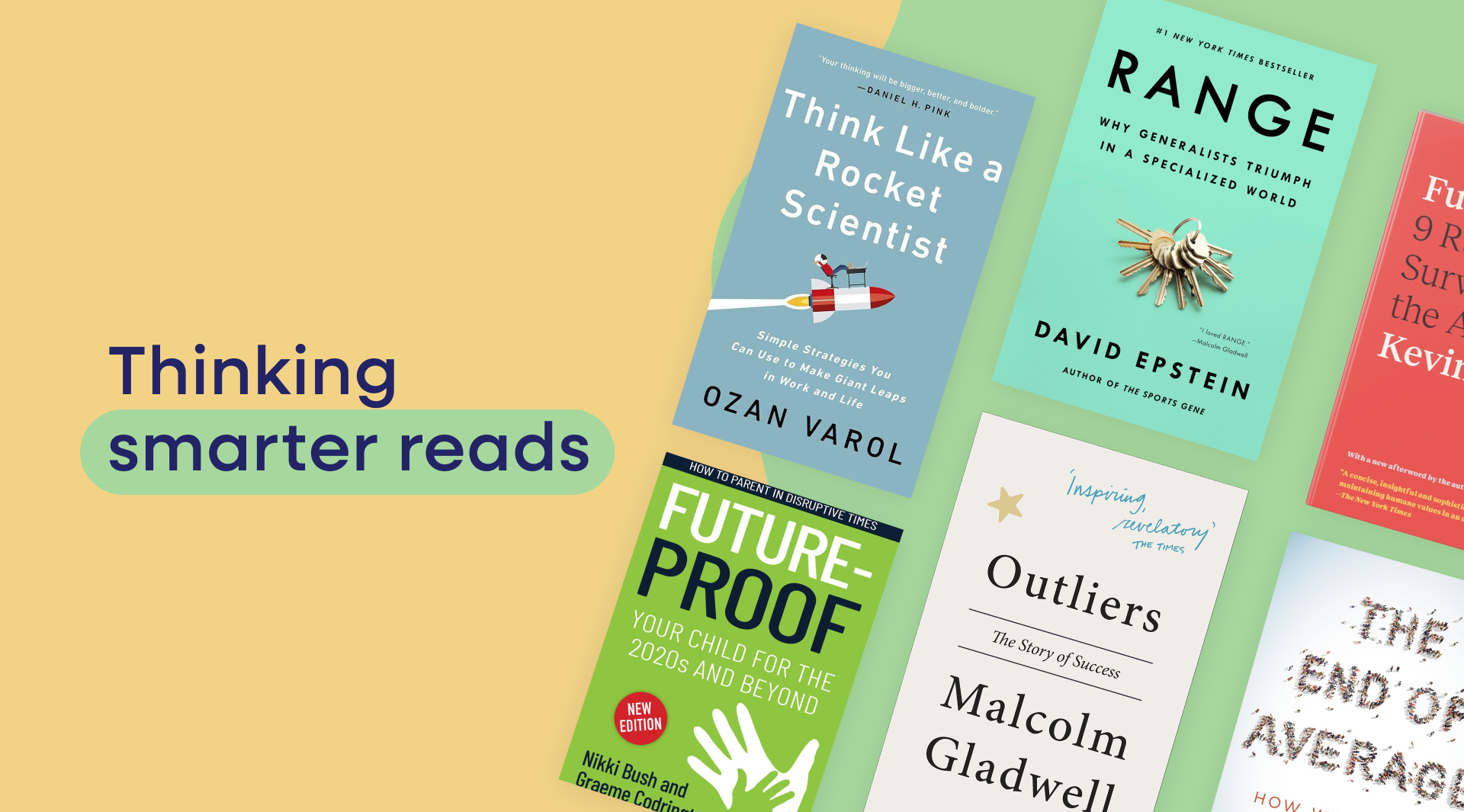
'Thinking smarter' reads
After our World Book Day Live on 23 April, it’s worth revisiting the role reading plays in how we understand learning itself.
If you missed it, you can catch the full live here: live.
It’s not just about what we learn, but how we think about learning, how we approach problems, and how we prepare for a world that is changing faster than most systems can keep up with.
The most valuable books don’t just give answers. They challenge assumptions, introduce new perspectives, and encourage better questions.
Here are a few that do exactly that.
Range — David Epstein
Range challenges the idea that early specialisation is the only path to success.
Instead, it argues that developing a broad set of skills and experiences often leads to stronger long-term thinking. Learners who explore different areas, make connections across disciplines, and adapt to new contexts are often better equipped to solve complex problems.
In a world that values adaptability, range becomes an advantage.
Futureproof — Kevin Roose
As technology continues to evolve, Futureproof focuses on the skills that remain distinctly human.
It explores how creativity, critical thinking, and the ability to work with uncertainty are becoming more valuable, not less. Rather than competing with automation, the focus shifts to developing strengths that technology cannot easily replicate.
It is a reminder that preparing for the future is not about predicting it, but about building the capacity to navigate it.
The End of Average — Todd Rose
This book questions one of the most fundamental assumptions in education: that learners should be measured against a single standard.
The End of Average argues that individuals develop in different ways, at different paces, and that systems designed around “average” often fail to recognise real potential.
It makes a strong case for more personalised approaches to learning, where progress is measured against the individual, not the group.
Outliers — Malcolm Gladwell
Outliers looks beyond talent and effort to explore the role of timing, opportunity, and environment in shaping success.
It highlights how access, exposure, and early advantages can influence outcomes in ways that are often overlooked. Success, in this sense, is not just about ability. It is also about the conditions that allow that ability to develop.
It shifts the conversation from “who is capable” to “what conditions make success more likely.”
Think Like a Rocket Scientist — Ozan Varol
This book explores how scientists approach complex problems.
Rather than relying on instinct or routine, they test assumptions, question existing thinking, and remain open to being wrong. This mindset encourages curiosity, experimentation, and a more deliberate way of thinking.
Applied to learning, it becomes less about finding the right answer quickly, and more about understanding how to arrive at it.
Futureproof Your Child — Dr Nikki Bush
Focused on practical application, this book looks at how parents can prepare children for a rapidly changing world.
It emphasises the importance of adaptability, resilience, and independent thinking. Rather than focusing only on academic performance, it encourages a broader view of what it means to be prepared for the future.
It brings the conversation back to everyday decisions and how they shape long-term outcomes.
Thinking smarter starts with asking better questions
Across all of these books, one idea is consistent.
Progress is not just about working harder or learning more. It is about thinking differently.
Reading, when done intentionally, exposes learners and parents to new ways of approaching challenges, understanding systems, and preparing for what comes next.
Because the goal is not simply to keep up with change.
It is to be ready for it.