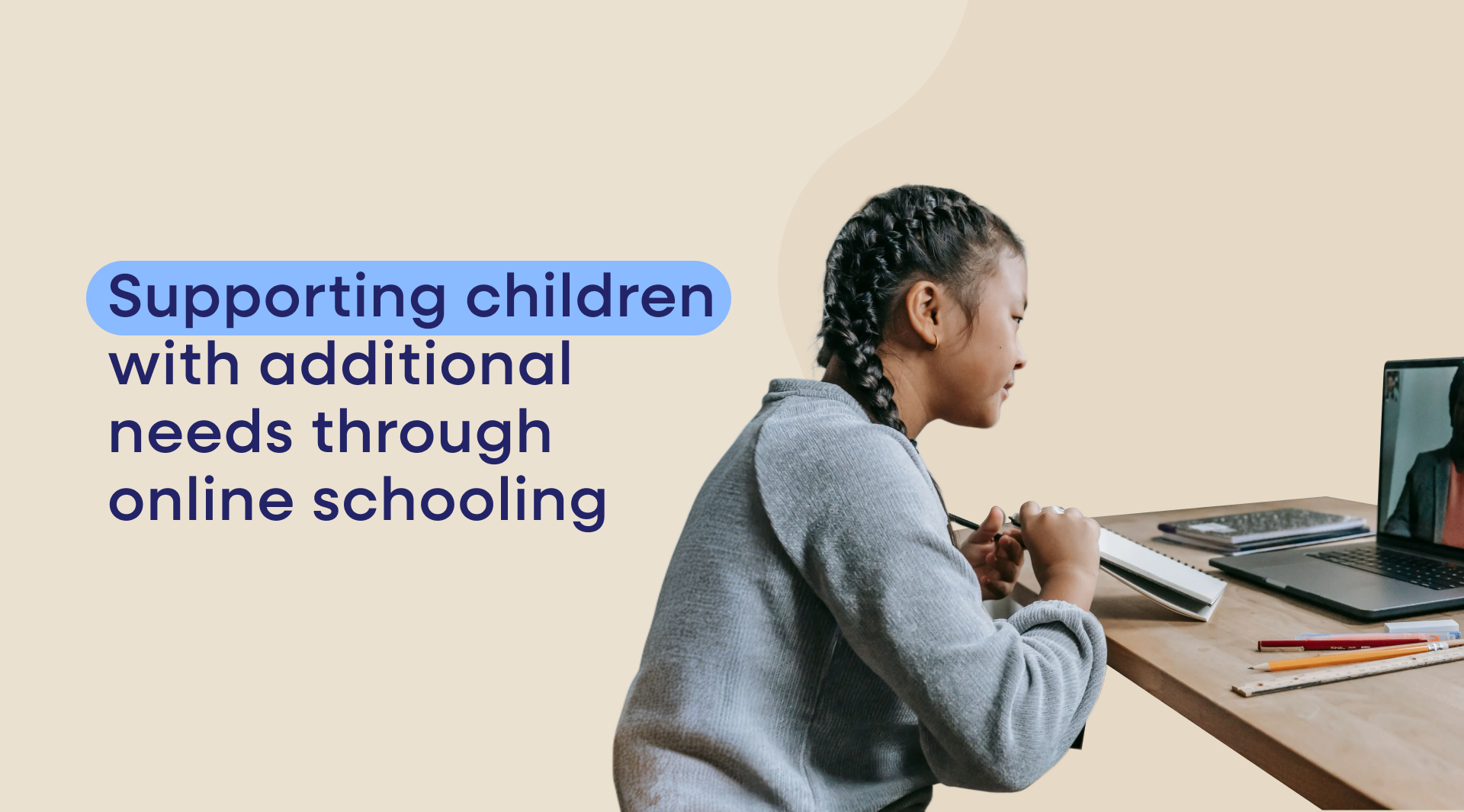
Supporting children with additional needs through online schooling
This guide explains how online schooling supports children with additional needs, what parents should do to make it work, and what to look for in a provider.
For many families of children with additional needs, the question is not whether mainstream schooling is imperfect — it is whether anything better exists. Online schooling, done properly, often is. A calmer environment, individual pacing, recorded lessons, smaller groups, and a system that notices disengagement early can collectively remove the specific barriers that make traditional schooling genuinely difficult for children with SEND — not by lowering expectations, but by changing the environment around them.
This guide explains how online schooling supports children with additional needs, what parents should do to make it work, and what to look for in a provider.
Who This Applies To
"Additional needs" covers a wide range of conditions and profiles, all of which can make a traditional classroom environment genuinely difficult:
Autism spectrum conditions, where the sensory environment, unpredictable social dynamics, and communication demands of a busy school can be overwhelming regardless of academic ability. ADHD, where the structure of a fixed classroom can conflict fundamentally with how attention and focus work for that child. Dyslexia and other specific learning differences, where text-heavy instruction and timed written assessment can obscure genuine understanding. Anxiety and school refusal, where the daily prospect of a large, socially complex environment creates genuine distress that compounds over time. Chronic illness, where variable energy, treatment cycles, and medical appointments make fixed attendance impossible rather than just difficult. Sensory processing differences, where the noise, lighting, and physical environment of a conventional school creates persistent overload.
In each case, the difficulty is often environmental rather than cognitive. The child's ability to learn is not the problem. The environment they are expected to learn in is.
What Online Schooling Changes — and Why It Helps
An online school does not treat additional needs. What it changes is the educational environment — removing the specific triggers that make traditional schooling hard while maintaining academic rigour and recognised qualifications.
A calmer, more controlled environment. No crowded corridors, no noisy lunch halls, no unpredictable peer dynamics between lessons. The learning space is the child's home — familiar, controllable, and significantly lower-stimulus than a busy school building. For children with sensory processing differences or anxiety, this is often the single most significant change.
Smaller live classes. A class of eight to twelve students with a qualified teacher is a fundamentally different social environment from a class of thirty. A child who would never raise their hand in a large classroom can participate comfortably. A teacher who knows twelve students can notice when one of them is struggling in a way that a teacher managing thirty cannot.
Recorded lessons for individual pacing. A child can replay an explanation as many times as needed, pause to process, rewind when a concept did not land the first time, and work at their own speed — without holding up anyone else, without the social cost of appearing to fall behind. For a child with dyslexia, processing differences, or a medical condition affecting concentration, this is not a convenience. It is the thing that makes learning possible.
Participation through channels that suit the child. In a live online class, a child can participate through chat rather than speaking aloud, can ask the teacher a question privately rather than in front of the group, and can engage at their own pace rather than competing with faster responders. For a child with autism or social anxiety, removing the public performance element of classroom participation lowers the barrier to engagement significantly.
Early identification of struggle. At Teneo International School, the Smart School System tracks every learner's engagement, attendance, quiz results, and submission patterns in real time. When something changes — fewer logins, declining quiz scores, work not submitted — the system flags it and a teacher responds. For a child who masks difficulty or withdraws quietly, this proactive identification means support arrives before the gap becomes serious, rather than after months of drift that go unnoticed.
What Teneo International School Does for Students with Additional Needs
Teneo International School operates an inclusive admissions policy — children are not screened out because they are neurodivergent or have additional needs. Around 30% of Teneo's learner base is neurodiverse, which means the school's practices are built around real experience of supporting these learners, not just a policy statement.
During the enrolment process, families are invited to share psycho-educational assessments, EHCPs, medical reports, or any other documentation that describes their child's profile. This information is used to plan appropriate provision from the first week rather than being retrofitted after problems emerge. Parents should share everything relevant at enrolment — the more the academic team knows about a child at the start, the better they can plan around them.
Teneo's teaching staff receive ongoing training in online delivery for neurodiverse learners — including how to recognise overload, adapt communication, support executive functioning, and provide feedback in ways that work for different learning profiles.
For specific access arrangements — extra time, a reader, a scribe, or a word processor in formal examinations — Teneo supports families through the application process. These accommodations require current documentation, typically from an educational psychologist or qualifying assessor, and applications should be made well in advance of the relevant examination year. Planning for IGCSE access arrangements should begin in Year 9 at the latest.
Setting Up the Home Environment
Online school transfers some of the structure a physical school provides into the home, and for children with additional needs, this requires deliberate setup rather than improvisation.
A dedicated study space matters. It does not need to be a separate room — a defined corner of a room used only for school helps a child shift into learning mode and leave it clearly at the end of the day. For children with sensory sensitivities, consider lighting, noise levels, and chair comfort. Add fidgets, a weighted lap pad, noise-cancelling headphones, or whatever the child has found helpful in other contexts.
A visual daily timetable — colour-coded by subject, with clear start and end times and marked breaks — reduces transition anxiety and removes the cognitive load of working out what comes next. Review it together at the start of each day. Keep it consistent.
Breaks between lessons are not optional. For a child with ADHD, autism, or anxiety, continuous screen time across a long school day is not sustainable. Build movement breaks, snacks, and outdoor time into the timetable as firmly as academic sessions. A child who is dysregulated cannot learn regardless of how good the teaching is.
Use recorded lessons strategically. A child who found a live lesson hard to follow can watch the recording later, in shorter chunks, at their own pace. This is one of the structural advantages of a good online school over a physical classroom — the content does not disappear when the lesson ends.
End the school day with a clear ritual. Close the laptop, pack books away, take a short walk. For children with ADHD or autism, a defined end to school time is important — without it, the school day can feel like it never finishes, which compounds anxiety and makes rest harder.
Monitoring Progress and Mental Health
Academic progress and mental health are closely connected for children with additional needs, and parents should monitor both actively rather than assuming one reflects the other.
The Teneo parent dashboard shows attendance, assessment scores, assignment submissions, and teacher feedback in real time. Check it regularly, not just when something seems wrong. A pattern of declining quiz scores in one subject, or a cluster of missed submissions, is worth raising with the teacher before it becomes a bigger problem.
Mental health needs equal attention. Signs that a child may be struggling beyond the academic include withdrawal from things they previously enjoyed, disrupted sleep, increased irritability or emotional volatility, frequent physical complaints around lesson times, or explicit statements that they cannot cope. None of these alone is conclusive, but a cluster of them warrants a conversation with the teacher and, where appropriate, with a GP, CAMHS, or a qualified therapist. Online school can reduce environmental stressors significantly, but it does not replace professional mental health support when a child needs it.
Making It Work: The Partnership Between School and Family
Online schooling for children with additional needs works best as a genuine partnership between the school and the family. The school cannot support a child it does not know, and parents cannot support a child whose school does not communicate proactively.
Tell the teacher everything relevant: what triggers the child, what calms them, what early warning signs of overload look like, which participation formats they find most comfortable, and what has worked in previous educational settings. Update this when something changes. The more concrete and specific the information, the more useful it is.
Involve the child in decisions wherever possible. Ask them which lessons they find hardest, which formats help them most, and what support would make a difference. Children who feel agency over their learning environment tend to engage more consistently than those who feel things are being done to them.
Set realistic short-term goals rather than focusing only on long-term outcomes. For a child rebuilding confidence after a difficult period in mainstream school, attending three live lessons a week, completing work on time, and participating through chat are meaningful targets. Recognising progress at each step sustains motivation better than measuring everything against the final examination.
Is Online School the Right Choice for Your Child?
Online school works well for children with additional needs when the home environment can provide a quiet study space, a reliable device, and consistent adult presence — particularly for younger students. It works best for a child who, given the right environment and support, is willing to engage with learning, and for families prepared to be actively involved rather than treating the school as a drop-off arrangement.
It is worth being honest about the cases where it is not the right fit. A child who requires intensive, daily hands-on therapeutic or physical support may need a provision that combines online academic delivery with in-person specialist support rather than online school alone. A child in acute mental health crisis needs clinical intervention as the priority, with educational decisions made alongside rather than instead of that support.
A good school will be honest with you about whether online schooling is the right environment for your child's specific profile. The admissions team at Teneo International School can discuss your child's needs in detail before any commitment to enrolment — and if a different provision would serve them better, will say so.
Frequently Asked Questions
Does Teneo International School accept children with SEND? Yes. Teneo operates an inclusive admissions policy and does not screen out children because of neurodivergence or additional needs. Around 30% of the learner base is neurodiverse. Share your child's documentation during the enrolment process so appropriate support can be built in from the start.
How does online school help children with anxiety or school refusal? It removes many of the environmental triggers that drive anxiety in traditional settings — crowded spaces, unpredictable social dynamics, public participation pressure — while maintaining academic structure and qualified teaching. For many children with anxiety or school refusal, the calmer environment is what finally allows them to re-engage with learning.
What happens if my child disengages quietly without saying anything? The Smart School System tracks engagement, submissions, and quiz results in real time. A change in pattern is flagged to a teacher, who reaches out proactively. For children who mask difficulty or withdraw without asking for help, this early identification is one of the most important features of the model.
Can my child get access arrangements for IGCSE and A Level examinations? Yes, with appropriate documentation. Extra time, a reader, a scribe, or a word processor can be applied for through the examination centre. Applications require current psycho-educational assessment and should be planned well in advance — ideally from Year 9 for International GCSE. Teneo's academic team supports families through the process.
Does online school work for children with chronic illness? Yes. Recorded lessons mean content is not lost during difficult health days or medical appointments. On high-energy days, a student can complete a full programme; on low-energy days, they can do what they can and catch up when they are able. Early planning of examination timing around health calendars is important, and the academic team can support this.
Will my child be socially isolated? Not if social contact is built deliberately. Live classes provide structured peer interaction; group work and clubs provide further connection. For children who found the social environment of a traditional school overwhelming, structured online interaction is often more manageable and more genuinely connecting. Families should supplement this with offline activities where possible.
What if online school does not work out for my child? Speak to the admissions team early and honestly. A good school adjusts provision when something is not working, and escalates to recommend a different setting if that is what the child genuinely needs. The goal is the right education for the child, not continued enrolment regardless of fit.
If you want to discuss whether Teneo International School is the right environment for your child's specific additional needs, the admissions team can have that conversation in detail before any commitment is made.